Hello everyone! 👋
First of all, German bureaucracy was a phenomenon we had heard about even while we were still in Turkey, and its very strict rules had made us quite anxious. Now, as we enter our fourth month in Berlin, I can say it is exactly as strict as we had heard, perhaps even more so.
Rules and order are given great importance in Germany. In other words, “Nein heißt nein.” That is, “no means no.” There is absolutely no room in Germany for exceptions or “Come on, make an exception for us.”
But once you learn the rules, taking care of the necessary bureaucratic tasks is very easy. Since many sources are in German, we found it a little difficult at first, too. In this post, I’ll try to share in detail our experiences and what we learned about dealing with official matters after arriving in Germany.
First task: “Anmeldung”
When explaining some of the procedures, I’ll use the German terms in particular. The reason is that in Germany people often use the German terms when talking about these things. In other words, even if you speak English to someone, they’ll say, “Do you have Anmeldung?” So, for some terms, it’s best to use them without translating them.
Anmeldung is translated into English as “registration” and into Turkish as “registering, giving notice,” but we can think of it as registering your residence. I’m covering this first because you absolutely have to complete it before you can take care of many other things.
In addition to being a prerequisite for dealing with government offices, Anmeldung is often required for things like getting a phone plan or opening a bank account. You could call this document the starting point of German bureaucracy. When inviting someone to a match or an event among friends, people even joke about this bureaucratic process by saying, “Bring your Anmeldung first!”
So why is Anmeldung so important, and why is it a prerequisite for other matters with official government agencies? The main reason is that bureaucracy in Germany is carried out almost entirely by “post.” Yes, you read that right—not email, but the ordinary mail delivered to our homes by the postman. To receive mail, we need an address registered in the government’s official system. “Anmeldung” is what gives us that.
Another important point is that once you complete your Anmeldung, your tax class is determined and a “Tax ID”—a tax identification number—is created for you. This information is very important to companies too, so your employer will ask you to provide it as soon as possible.
I explained how to apply for Anmeldung and the whole process in this post in detail. While we point friends who are preparing to apply for Anmeldung to that post, let’s move on to the other important tasks.
Getting Health Insurance
Health insurance is also an important document required when applying for a work visa or Blue Card while still in Turkey. As stated in the visa application, it was enough for us to have this insurance until the day we started work.
This insurance covers us until we start work, and we’re also expected to arrange our insurance for the period after that. To avoid any confusion here, let’s briefly talk about Germany’s social security system.
Although there are many different types of insurance in Germany, we’ll stay on topic and focus on health insurance, or “Krankenversicherung” in German. Since Germany is a social welfare state, the law requires everyone living in Germany to have health insurance. There are two types of health insurance: public health insurance and private health insurance.
Everyone earning more than 450 euros a month (for 2021) has to take out insurance. But can everyone get private health insurance? Our answer is no. Unlike in Turkey, to take out private health insurance your annual gross salary has to be above a certain amount (64,350 euros, the 2021 figure).
Our second step was to arrange our health insurance, both because it was legally urgent and because we would need it for other bureaucratic procedures. We choose our insurance provider and share its details with our company. After that, we don’t make any payments ourselves. To avoid any misunderstanding when I say that we arrange our insurance, let me clarify this: we apply to the insurance company, but we don’t make any payments. Our employer pays the insurance premiums.
Let me continue by describing the process based on my own experience. When I asked HR about this during my onboarding meeting on my first day at work, they gave me the names of insurance providers that had agreements with our company. We’re free to choose any provider we want. Going with one of the names the company provided helped the process move faster and made it easier for me to get quick answers to my questions. Of the different insurance providers, I chose TK because they offer support in English and are also frequently chosen by “expats.” Those were the most important factors influencing my decision.
As for my experience with the application and completing the insurance, it consists of very simple steps. You apply by filling out a form on the website. Then a PIN arrives by post so you can upload the photo that will appear on your card. Once you upload the photo to the system, your card is delivered to your address by post as well. Before the card arrives, once all the procedures are complete, they also send you a “confirmation letter” stating that you are now insured by TK—both by email and by post. You need to send this document to the relevant person in HR at your company. This document will also be important for your Blue Card in the next step. So, let’s move on to the Blue Card without wasting any time.
Applying for a Blue Card in Germany
The Blue Card visa you receive from the Consulate General of Germany in Turkey is actually a temporary visa. This is emphasized when it is issued. The visa, which is stamped into your passport, is issued for six months, and one of the most important things expected of you is to apply for the Blue Card that will be printed on a card at the Foreigners’ Office in Germany.
Since this application is also very important, I’ve gathered all the necessary details and our own experiences in this post for anyone who wants to read the details.
Change of Address at the Turkish Consulate
One important thing to do after settling in Germany is to notify the Turkish Consulate of your change of address. In other words, you’re saying, “I now live in Germany.” According to our laws, we have to notify the government of any change of address, so this is something we need to do. If you don’t do it on time—it has to be done within 20 days—you’ll have to pay a fine. Another important point is that if you haven’t informed the Social Security Institution (SGK) about your new address and job, you could end up with SGK debt. Notifying the consulate also prevents SGK debt from accruing.
First of all, making an appointment at the consulate before you go will help you complete your procedures more easily and quickly. We went with an appointment, but when we got there, we saw that they were also processing people who had come without one. You need to use the official website of the Turkish Consulate to make an appointment. For the Berlin Embassy, we used this site .
Since you’ll be declaring your address, I recommend taking your Anmeldung with you. We handed our document to the official during the process without being asked. In our online research, we had read that some officials simply accept your declaration as true—for example, “I moved to this address on this date and now live there.” But to avoid any risk, I recommend taking your Anmeldung document with you as well.
When it’s your turn, you give your documents to the official or declare the date from which you’ve been living at your address. The official enters this information into the system, and the process is done. It’s a very quick procedure. I recommend taking care of this on time, both to avoid a fine for failing to report your change of residence and to avoid SGK debt.
Radio and Television Tax
I thought for quite a while about whether to give this topic its own heading, but I think it’s best to cover it while we’re talking about bureaucratic matters. Even though this tax is often considered unimportant and is disliked by expats, as long as you don’t pay it you can face penalties, and it will also have a direct negative effect on your credit score.
So what is this radio and television tax? Basically, you could say it is a tax that funds radio and television broadcasters, whether public or private, so they can operate. This may raise the question: “Why do we pay taxes to the government and then pay another tax to a separate organization?” There is actually a very good explanation: it is to make radio and television—in other words, broadcasters—completely independent and free from government influence. In fact, the taxes collected from the public go directly to this organization. Not even an intermediary government agency is involved.
The latest amount can be checked on their official website . But as of 2021, we pay 18.36 euros a month. It’s enough for one person in the household to pay it. For example, since my wife and I have the same registered address, only I owe it, and the bills come to me.
After you register your Anmeldung, your address is added to all the government’s official records, so after a while you receive a letter like the one in the picture below. It shows your current balance and when you need to pay it. If you don’t pay on time, interest accrues, and this debt directly affects your credit score too. In other words, ignoring the letters is not a good option at all.
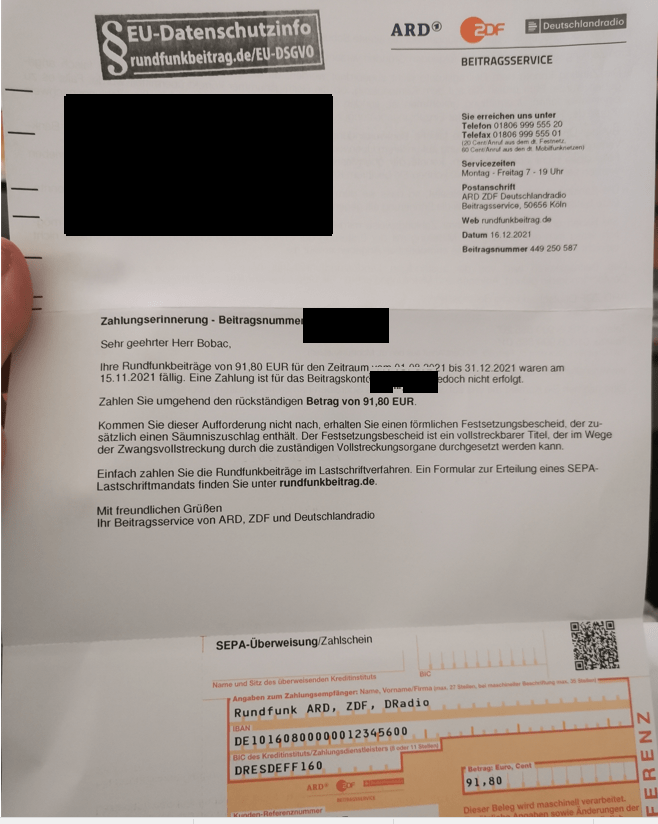
But what if we don’t use German radio and television, and we don’t even have terrestrial or satellite reception at home—do we still have to pay? Our answer, unfortunately, is “yes.” I think this tax is one of the most disliked and most debated topics among expats.
But here is the government’s explanation: “You have an internet connection at home, and you even have mobile data on your smartphone. You can use these to access TV services. So even if you don’t have terrestrial or satellite reception at home, you’re still liable for the tax.” I think that’s a reasonable explanation too.
I’d read in various groups that some people had taken this to court and that some had even canceled their home internet, but they still had to pay. In short, there’s no getting out of it—we have to pay 🙂
As for payment, there are two options. The first is to share your bank account details with the organization and authorize them to withdraw the set amount from your account each month. (You can do this online or by post .)
The second option is to transfer the money to the organization’s IBAN, entering your subscription number in the payment reference. The organization’s IBAN can vary by state. You can transfer the money to the IBAN shown at the bottom of the letter you receive, in the section that looks like an optical form, or check the IBAN on this site by selecting your state.
After settling in Germany and taking a little time to recover from the move and enjoy the country, it’s very important to set aside time for these bureaucratic procedures and take care of them without delay. That way, you can prevent both fines and negative consequences that could affect your financial situation and residence permits in the future. In this post, I’ve talked about the bureaucratic tasks we experienced ourselves. I hope it was helpful. You can always get in touch if you have any other questions.
Goodbye.

