During the process of moving from Turkey to Europe, the work visa that impressed us most with its benefits was the Blue Card. In fact, when applying and speaking with companies, we made being eligible for the Blue Card a prerequisite.
I covered the details of the Blue Card in this post, and also explained in detail in this post how we applied for a Blue Card in Turkey. Today’s topic is a little different. In this post, I’ll share our experience of turning the temporary Blue Card visa stamped in our passports in Turkey into an actual card in Germany.
First of all, even if your application from Turkey is approved, the Blue Card you receive is not a real, physical Blue Card. It is stamped on a page in your passport and has an expiration date. For example, our visa was issued for entry into Germany on August 25, 2021, and was valid until February 2022. One of the most important things expected of us after arriving in Germany was to gather the other required documents and apply for a real physical card at the Foreigners’ Office. We must do this before our visa expires. A small tip: since these procedures can take two or three months to complete, don’t leave it until the last minute—make sure to apply at least two months before your visa expires.
As with many procedures in Germany, there are a few prerequisites for this one too. First, we need to have completed our Anmeldung and obtained health insurance. You can read this post for these procedures. After completing our Anmeldung and getting health insurance, the first thing to do before moving on to the other documents is to book an appointment.
We apply for a Blue Card at the “Einwanderungsamt,” or Foreigners’ Office. Getting an appointment with this agency is really difficult, but it’s possible with a few tips. Even so, you may not be able to get one for a very near date. Since there are no other prerequisite procedures after completing your Anmeldung and getting insurance, I recommend booking an appointment as soon as you’ve done those. Now, let’s see how to book one.
Let’s Start by Booking an Appointment
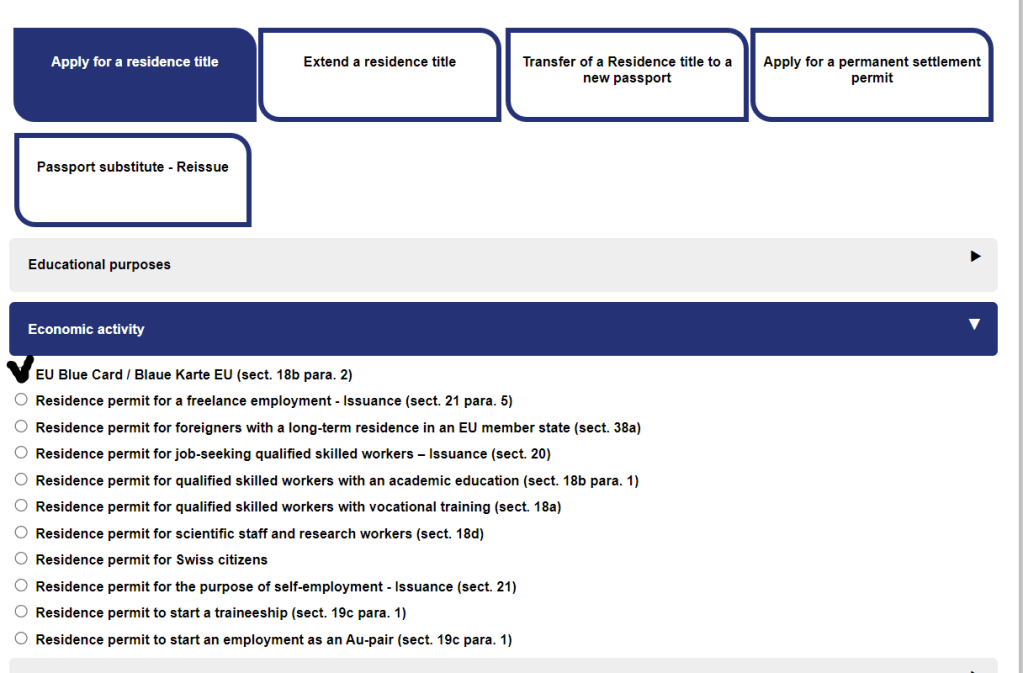
Since appointments may differ by state, let me start by saying that this post explains the booking steps for the state of Berlin. You can apply at this address . In addition to your personal information, the application asks why you want an appointment. Here, you need to select “Apply for Residence,” then “Economic Activity,” and “EU Blue Card.”
After clicking “Next,” we reach the most problematic point: “selecting a date.” At this stage, you’re likely to get a warning like this:
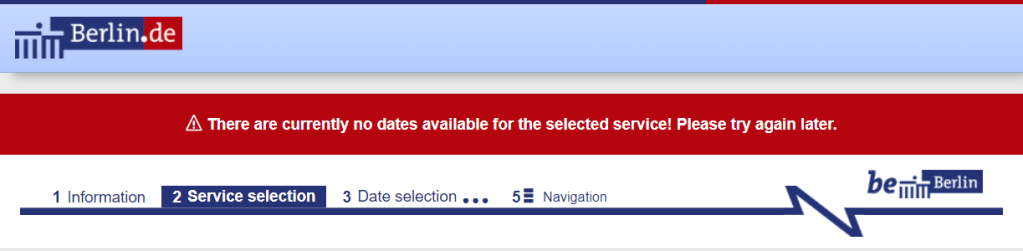
It’s really difficult to find an available appointment date on this platform. But I can offer a few tips. Based both on my own experience and on what I’ve read in various expat groups, I can say that appointments are generally available for applications made on Tuesday or Wednesday mornings between 08:00 and 10:00.
I don’t know why, but even though I failed in all my attempts on weekdays and weekends, around 08:10 one Tuesday morning I finally managed to book an appointment for two weeks later. Another tip: if you get this error the first time, be sure to refresh the page and keep trying. Unfortunately, even though it’s a little frustrating, it definitely works. But as I said earlier, I strongly recommend trying on Tuesday or Wednesday morning.
The Next Step Is Preparing the Documents
Once we’ve managed to book an appointment, the next step is to prepare the documents. Since we’ve already made this kind of application in Turkey to come to Germany, we can actually prepare many of the documents quickly. It may be helpful to go over a few critical points about the documents again. The most up-to-date list of required documents is available on the official website .
- Application form. You can get this form from the website above.
- Passport. It’s very important to have the entry stamp for Germany in your passport. If there was an issue with the airport police stamping it, I recommend discussing this with the authorities before your application. A missing entry stamp in your passport can cause problems.
- Biometric photo. You can use a photo that meets the same standards as the one used for your application in Turkey.
- University degree. You must bring the original and, if it doesn’t include an English description, an English translation too. They make a photocopy and return the original to you.
- If you didn’t graduate from a university in Germany, bring the anabin recognition for your degree and university. You can provide this just as you did for the application in Turkey. I’ll also share my post about this document here .
- Job offer. The important point here is that they ask for the original. Of course, even an online offer has to be printed out. But two things may help: first, you can bring a color printout. Second, your signature can be handwritten. It’s also helpful to bring a color printout of an offer signed by both parties electronically. In other words, our aim is to avoid giving the impression that it’s a black-and-white photocopy as much as possible.
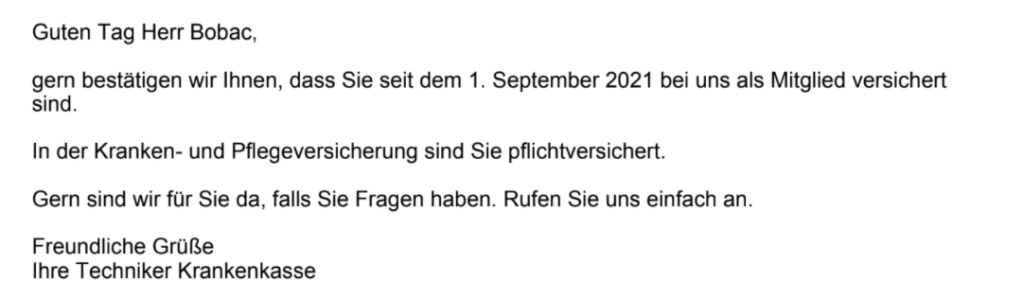
- Health insurance. After your health insurance is approved by the insurance company, they send you a document. It states the date your coverage starts and what it covers. This document will be sufficient for your application. If your insurance company hasn’t provided you with one, contact them and request a document like this for your Blue Card application. For example, the document I received looked like this:
- Rental agreement. The requested documents don’t explicitly mention this item. However, the requirements include “living in Berlin.” Since they don’t specify how to prove this, I brought my Anmeldung document. But in addition to the Anmeldung, they also asked for my rental agreement. I think they wanted to see that I had rented a place for a specific period. Since I didn’t have it with me at that moment, I panicked a little, but I sent it to them by email right away and it wasn’t a problem. So, I recommend bringing your rental agreement too.
The Appointment Day
When our turn came, we gave the required documents to the officer, who photocopied some of them and returned the originals. Then they gave us a card that looked like a bank card. We used it to pay the Blue Card fee at the machines in the application office.
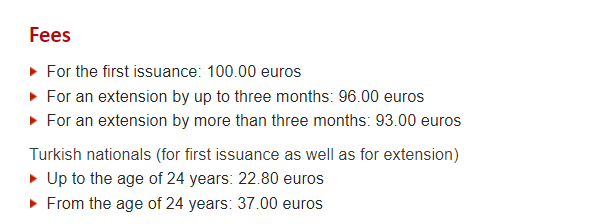
There’s a nice benefit for citizens of the Republic of Turkey here. For example, while other countries pay around 100 euros, Turkish citizens pay 37 euros. I think this is a positive result of the labor agreement signed in the 1960s. The most up-to-date information is available here too. For 2021, the fee was as follows:
After making the payment, you return to the officer’s office. At this point, they take your fingerprints, ask your height and eye color, and then complete the process. Before leaving the office, I recommend saving the email address of the officer you dealt with. It will be very useful for getting in touch directly if something goes wrong. Their first and last name and email address are on their desk. The officer actually asked me to take a photo of the email address and save it without me even asking.
What Happens Next?
We’ve completed all the procedures, and now it’s time to wait. Before you start waiting, be sure to remember that your name must be on both the doorbell and mailbox at your registered address. After this stage, both your PIN and your Blue Card will arrive at your address by mail. If your name isn’t on the mailbox and doorbell at the address where you’re registered, your card may be returned. That would mean dealing with a lot of extra bureaucracy all over again.
Another issue is moving house before your Blue Card arrives. First of all, you need to report every change of address to both the Bürgeramt and the Foreigners’ Office. Of course, this is something important to do even after your Blue Card arrives, just like changing your registered address in Turkey. But during the Blue Card process, it becomes even more critical.
If a problem arises because of a lack of communication between the agencies, your Blue Card may not reach you. This actually happened to a colleague at my company. They changed address before their Blue Card arrived. Even though they reported the change, unfortunately the card didn’t reach them. After many more emails failed to resolve it, they had to go to the Foreigners’ Office again. So let me share our experience that address changes can cause problems like this.
If everything goes well, you first receive an email. It tells you that your Blue Card has been approved and is being processed for printing. At this point, if you haven’t received an email like this after about fifteen days, I recommend emailing the contact address you saved to ask about the status of your application.
This approval email is very short and comes with an attached document. The attachment says that your Blue Card has been approved and is valid until a certain date. Based on our research online, we formed the following understanding about the Blue Card’s validity period: indefinite employment contracts get the maximum validity period of four years, while fixed-term contracts get a Blue Card valid until the end of the employment contract. Since our employment contracts were indefinite, our approval stated that we would receive a four-year Blue Card. Another important point about this approval email is that, unfortunately, it does not replace the Blue Card. For example, companies can’t use this approval document in place of the Blue Card. So we still have to wait for the Blue Card for official purposes.
Of course, this approval email is a very important step and gives the impression that your Blue Card will arrive soon. But I’d say that even after this email, it can still take two months for the Blue Card to arrive. Before your Blue Card, a letter with your PIN arrives in your mailbox. Although this PIN doesn’t directly affect your ability to use the Blue Card, you use it for government services online. I can’t say its use is very widespread at the moment. For many government procedures, you generally still have to book an appointment and apply in person.
By the way, although the PIN arrives first in most cases, apparently sometimes the card arrives first. In our case, the PIN arrived first. We received a letter containing the PIN about two weeks after being told our application had been approved. The Blue Card arrived about two months after the PIN. For my spouse, a month passed between the PIN and the card.
Although the timing varies, in urgent situations—for example, if the expiration date of the Blue Card in your passport is approaching—be sure to contact the Foreigners’ Office by email to ask about the process and even request that they speed it up. They always respond to requests sent by email.
When your card and PIN arrive, you can follow the steps in the PIN letter to activate your card for online services too. Another important point about the Blue Card: you must report any job changes to the Foreigners’ Office during the first two years. After two years, you no longer need to report job changes.
At this point, after a long and challenging process, you’ll finally have your Blue Card, a residence and work permit that provides many benefits for you and your family. Let’s wrap up by wishing everyone success through this difficult process.
See you.

