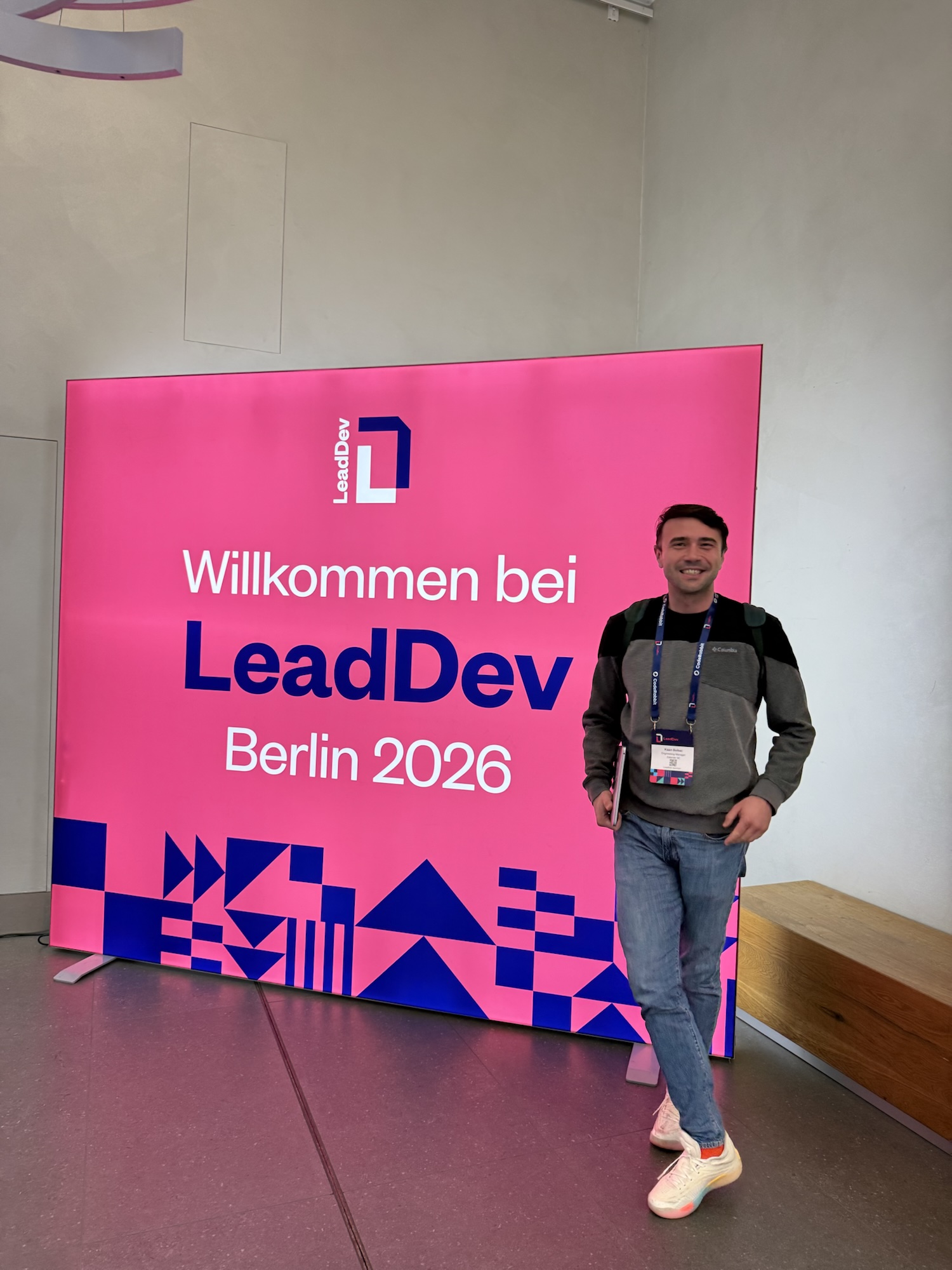
This week, I joined LeadDev Berlin for the fourth time, and it was my second time hosting a table talk. I love those conversations: you put people with different perspectives around a table, openly discuss a challenge many of us share, and leave with a few “aha” moments you probably wouldn’t have reached alone.
There were many excellent talks and workshops, but before getting to those, I want to start with the atmosphere in the exhibition hall.
The first time I came, four years ago, the stands were mostly about developer tools: observability, better incident management, and testing. There were also companies offering outsourced software engineering. The talks covered architecture, teams, and people management, and there wasn’t nearly as much AI wording around the event as there is today.
Last year, the picture had started to change. There were more tools with AI assistance, although many were still recognisably productivity or observability tools. There were also plenty of stands offering outsourced engineering capacity.
This year, almost every stand seemed to have an agent in its story: a learning agent, an agent for incidents, or a system covering much of the software development lifecycle. The talks, too, explored working with agents, using them effectively, and finding new ways of working. I didn’t see any outsourcing companies in the exhibition hall this time. I’m not mentioning that to create confusion or anxiety; it was simply a striking change I noticed, not a conclusion about the whole market.
Watching that transformation across the years was fascinating. I had already started wondering what the same hall will look like next year.
Turbulence
Anyway, let’s get back to the event itself. One of the things that stayed with me from the keynote was a LeadDev survey that asked engineering leaders for one word to describe their experience of 2026. The word was “turbulence.” I wouldn’t have chosen it immediately, but after thinking about it, I would definitely agree.
Turbulence isn’t necessarily a bad thing. Unless you’re on a plane, of course.
What we’re experiencing as leaders certainly feels turbulent, and it isn’t only happening to us. The people in our teams are trying to understand what all these changes mean for their work, too. If part of our job is to help the team navigate that uncertainty, then I think that job is becoming even more important.
One reason I enjoyed the conference was hearing how other people are navigating it: the things that worked, the things that didn’t, and the questions they haven’t answered yet. I can’t reasonably cover every excellent talk here, but I do want to share the ideas I took home.
When code stops being the bottleneck
The first surprise was how much further some teams have gone with agents in the development loop than I had realised.
For me, writing every line of code by hand isn’t the way I choose to work anymore. Where I’ve been more cautious is what happens after the code is written: the review, sometimes the verification, and the question of who is accountable for the pull request.
Maybe that’s a trust issue. Or maybe it’s the control freak in me as a manager. Either way, my starting position has been that people need to take accountability for their changes and that a human reviewer should understand what they’re approving. Of course, that reviewer can—and I would say should—use AI to help. We also have an auto-approval process, which I think is fine when the change isn’t risky.
What I heard at the conference went further. Speakers described agent-to-agent review and, in some cases, changes being reviewed and deployed without human involvement at all. One talk mentioned nine out of ten and another two-thirds when discussing these automated workflows. And this wasn’t a discussion about ten pull requests: a volume of more than 2,000 pull requests in a month also came up. You might be asking now: yeah, but how about the failure rate? Interestingly, the same speakers mentioned a decrease in incidents or failure rates. Yes, you read it correctly, a decrease. That was definitely interesting.
Those are reports from different talks, not a comparison of identical teams. My notes don’t capture the exact definitions and baselines behind each figure, so I wouldn’t treat them as industry averages or proof that the same approach is safe everywhere. But hearing them at that scale made me want to understand the practices behind them.
And yes, the questions about maintainability and best practices were already forming in my head, too. We’ll come back to those. First, the review process itself was interesting enough to look at.
A reviewer whose job is to challenge
One concept that came up was adversarial review. Instead of looking at an AI-generated design or implementation mainly to confirm that it looks right, a reviewer actively tries to find where it might fail.
Imagine a builder agent proposing a retry after a payment request times out. A separate reviewer—another agent or a person—might ask: could that retry charge the customer twice? A useful finding should give us something we can check, such as a counterexample, a failing test, or a concrete failure path. The builder can then fix a valid issue and run the checks again.
This is broader than security red-teaming. The reviewer is challenging the solution and its assumptions, including edge cases and operational behaviour, not just looking for a security problem in the code. It complements testing and human accountability; it doesn’t replace them.
Another setup described at the event gave every pull request two different review jobs: conformance and refutation. The conformance reviewer looked at whether the change followed the requirements and conventions. The refutation reviewer had a different mission: try to find the cases that could break the system, including the ones that make you wonder who on earth thought of them.
I also heard about context-specific roles. For example, a reviewer specialising in database-related changes and another specialising in frontend code don’t both need to be triggered for every pull request. The relevant expertise can be brought in when the change calls for it.
I like the driver-and-challenger idea. They have different jobs, and a challenge can expose an assumption the builder missed. But I also have questions about the boundaries. What happens if the builder and reviewer keep arguing in an endless loop? How many tokens are we prepared to spend before the discussion stops adding value? What stops a reviewer from pulling a small change into a much bigger, out-of-scope refactoring?
The reviewers’ findings still involve judgement. Before trying this, I’d want to define the scope, set a limit on review rounds or resources, and decide when a disagreement needs a person. Otherwise, a simple change could become an incredibly complicated agent conversation.
Today, I use AI review on pull requests. What I’d like to try is moving a builder-and-challenger pair earlier, before the pull request is even created, so the first round of issues can be addressed before it reaches a human reviewer.
But wait. If the reviewer agent has challenged the builder, the findings have been addressed, and the checks pass, could that agent also approve the pull request? That’s where my trust question returns. Some of the teams at the conference are already allowing much more of that workflow to happen without a person in every loop. Maybe it is possible. I want to understand what makes them comfortable with it—and what evidence would make me comfortable, too.
We may not read every change, but we still need to understand it
After one talk, I was interested enough in this question that I grabbed a coffee with the presenter. We spoke about a related problem: how do we stay aware of changes when the amount of code being produced keeps growing?
Previously, a lot of our confidence came from being the people who wrote the code, read it, and approved it. Now an agent may write it, and either a person or another agent may approve it. In both cases, there is a risk that we approve changes we don’t fully understand.
I don’t think that is simply because people aren’t paying attention. There is a limit to how much we can read, and the discussions at the event pointed to both more pull requests and larger changes. We’re still human. If we insist on catching up with every change in exactly the same way as before, review itself may become the bottleneck.
That doesn’t mean understanding the system is no longer important. It means we may need a different way to stay in sync while respecting the same principle. During our coffee, we wondered: who needs to be aware of all those changes—us, our agents, or some combination of both?
Imagine your product manager asks about a change deployed yesterday. The pull request touched 5,000 lines of code, but their question concerns one small piece of functionality. Is rereading the entire change the best way to answer? Could an agent help locate the relevant part and explain it, while we check the answer against the change and its intended behaviour?
The same question applies beyond the next deployment. Faster approvals, or even fewer reported incidents, don’t by themselves tell us whether the code will remain understandable and maintainable. We still need ways to notice when a series of individually acceptable changes is moving the system in the wrong direction.
I heard that some teams are also experimenting with agents that follow a deployment and watch for possible SLO problems. Imagine an agent that connects to a new deployment with a concerning signal and checks all failures and SLO violations, and if something looks unexpected, sends a signal to a human for a rollback decision. That sounded futuristic to me, but also worth trying. There’s nothing wrong with giving it a try on a small, less business-critical path. Even a failed experiment could teach us where this approach helps and where it doesn’t. Or, in other words, a failure can still be a good experiment.
That brings me back to a theme I heard a lot throughout the event: trust. One speaker’s point was that coding used to be the bottleneck, and now the bottleneck is trust. I can only second that.
If we want to give an agent more autonomy, we need more than a reassuring approval message. We need to understand what checks are in place, what they cover, and what happens when something falls outside those boundaries.
One talk discussed layered guardrails, including hooks, skills, and progressive disclosure. These aren’t interchangeable. In an environment that supports them, a hook can run an action at a particular point in a workflow; a skill can package instructions and resources for a particular task; and progressive disclosure can bring in more detail when it’s needed rather than loading everything at once.
For example, an automated check can enforce a rule we know how to test, while a specialist reviewer can examine a question that needs judgement. A skill might help the agent follow a relevant procedure, but having the instructions available doesn’t guarantee that the agent followed them correctly. The point is to combine appropriate layers rather than assume that any single one creates trust.
I’ve written more about these tools and when they earn their place in To Harness or Too Much Harness?. What I took from this talk was the connection to the leadership decision: which checks can we make deterministic, which still require judgement, and where should a person be involved?
Trusting the work is one challenge. Deciding whether we should be doing that work in the first place is another. That was close to the topic of the table talk I was privileged to host: how do we deliver value for engineering teams?
We started with the obvious question, which turned out not to have such an obvious answer: what do we mean by value? It could be a tool that helps an engineering team work more effectively. It could also be something that improves a customer’s experience. Both can matter.
We also acknowledged that shipping things is becoming faster. But shipping faster doesn’t necessarily mean we’re shipping the right things. One talk shared an example of a team creating more than 50 dashboards in a year. After an audit, only two had demonstrated value, and dashboards were retired. I don’t have all the details of that audit, but the question it raised for me was clear: how often do we stop to check whether the things we built are actually helping?
For me, value is a step towards the vision of the team, whether that is an engineering vision or a product vision. The step can be small or large, but I want to understand how it helps us make progress along that path. That makes evaluating what we build more important, not less, when we can build more of it.
Once we have some alignment on the value we’re trying to create—with the team, our product counterpart, or both—the next question is how to help the team deliver it. Since the beginning of my time as an engineering manager, I’ve heard that managers should remove obstacles and improve productivity. I still believe that. But today, I think steering the focus is just as important: helping the team use this powerful magnifier on the problems that actually move us forward.
During the table talk, someone asked me how we measure the success of AI. It wasn’t exactly the question we had started with, but it was clearly on people’s minds, and it connected back to the discussion.
Honestly, I don’t have a complete metric-based system for answering it. One thing I would discourage, though, is treating token consumption as a success score or creating a token leaderboard. What we measure can influence what people optimise for. If the goal becomes using more tokens, it’s easy to move away from the outcome we actually wanted. Token usage can still matter for understanding cost; it doesn’t tell us on its own whether we created value.
My answer came back to the value we create. Another person at the table immediately asked what I meant by “value,” which brought us right back to the beginning of the conversation.
I deliberately don’t want to define it only as “value for the customer,” because a real benefit today doesn’t always point in the direction the team has agreed to go. Imagine we build a brilliant internal tool that helps our internal users do a manual task. They are happier, and that is a real benefit. But if the vision of the department or team is to automate that task, and the tool only makes the manual process easier without moving us towards automation, how does it fit our longer-term direction?
That doesn’t mean the users’ problem is unimportant or that we should never build the tool. It means we should make the trade-off consciously rather than assume that a useful output automatically advances our vision.
I enjoyed hearing how differently people thought about this. The question wasn’t just how much AI we were using; it was what we were using it for, and how we would know whether it helped.
There were too many good talks and conversations to do all of them justice here. If I had to summarise my own takeaways from the two days, they would be these:
- Trust needs deliberate attention. As we build justified trust in agents and the systems around them, we may be able to reduce routine human involvement in some workflows. The amount of oversight should still depend on the risk and evidence.
- Use deterministic guardrails where they fit. Automated checks and rules can enforce some boundaries; other questions require judgement. An AI review can help with the latter, but it is not a guarantee.
- The principles remain. We’re still accountable, and we still need to understand what is changing. How we stay in sync may need to change so we don’t have to catch up with every line one by one.
- Run experiments, including ones that might fail. If we don’t try anything, we won’t learn which approaches work for our teams or where their limits are.
- Our ways of working need a rethink. To me, Scrum and other familiar SDLC practices feel outdated for some of the ways we’re beginning to work with agents. Do we have a clear replacement yet? I haven’t seen one, but I heard plenty of different experiences worth learning from.
- People management is still a top priority. We also need to learn how to manage the agents and workflows our teams use, without confusing that with managing the people themselves.
I’m leaving with more questions than a complete playbook, but that’s one of the reasons I value this event. The conversations made the turbulence feel a little less like something each of us has to navigate alone.

