Hello everyone! 👋
For anyone who missed how our decision to move abroad began, let’s start by recommending this post where I explained in detail how we decided to leave after seven years of my career at my first company, and our main motivations for moving abroad.
When we decided to move abroad, we didn’t have any particular country in mind, and many options were on the table. After a lot of research, we settled on Germany, and now my wife and I work in Berlin as software engineers. In this post, I’ll try to explain in detail what we learned during our research and why we chose Germany.
Waking Up from the American Dream

Once you decide to move abroad, the first step is, of course, applying for jobs. If you have a specific country in mind, great! Start applying right away through career sites like LinkedIn or Glassdoor. You can also take a look at this post where I shared our experiences with job interviews abroad.
But if you don’t have a country in mind, you have a period of making a decision and examining and eliminating the options on the table one by one ahead of you. So, let’s get started.
✅
Since I’ll be talking about our own experiences in this post, I’ll use the examples of my profession, Software Developer, and my wife’s, Software Test Engineer. I believe the things we considered in our research and when comparing countries will also be useful to friends in other professions, beyond our own experiences.
When we started looking for work, our first target was the United States—perhaps aiming a little too high. The main reason behind this was, in a manner of speaking, “American Dream.” I think Hollywood movies had influenced us a little from a young age, and we began our research thinking the country must be paved with gold.
Joking aside, in the forums and various blogs we followed, America was always at the top of the list as the best country for a software developer to work in. The main reasons given were the salary ranges and benefits offered to attract the best software developers, along with the abundance of job opportunities. In our eyes, it was also a land of opportunity in terms of support and access to investors for the “start-up” we definitely wanted to launch at some point in our careers.
Of course, America also came with some challenges, such as being very far from Turkey and having a time difference that was almost impossible to manage. But, while our careers and circumstances allowed us to, giving it a try at least once was definitely exciting for us. With those feelings, we started applying to many companies in America. We applied to many companies and job listings, without distinguishing between states or cities.
After a long application process, we had submitted more than two hundred applications. It was a huge disappointment that, despite all the rejections, none of our processes moved forward. But a few weeks later, a request for an interview from Uber’s San Francisco office got us very excited, and our fading hopes began to bloom again.
The day of the Uber interview finally arrived. I was very excited, both because it was Uber and because someone from the San Francisco office had contacted me. Since it was an HR interview, we started by talking about my experience. I described my whole background in detail, starting with my university graduation. Their interest in my career and what I’d done motivated and excited me even more.
Then the HR representative began explaining the details of the position. After giving me a lot of information about Uber, they moved on to Uber’s Denmark office and began explaining things in more detail. I was listening, a little worried and a little surprised, wondering, “Why Denmark all of a sudden?” while trying not to let the other person see my surprise.
But I was completely shocked when they suddenly asked, “Would living in Denmark be a problem for you?” They explained that the listing I’d applied to was a general posting and that they wanted to establish a new office in Denmark and grow there. They had added “relocation to Denmark” somewhere in the listing, but in the rush of applying to so many jobs at once, I hadn’t really noticed.
When I said I was interested in a position in America, they told me it was difficult to get a work permit there, that they generally considered people who already had a work permit or a green card, and that they didn’t sponsor visas.
After that interview, I was sad in one way but also glad in another. I was glad because, although getting no response had hurt our motivation, I realized it had more to do with work permits than with our past experience or the skills on our CVs—and that companies generally didn’t want to go to the trouble of sponsoring this visa. I was sad because the “American Dream” had ended for us before it even began.
As a small side note, I’d like to share this memory. A month or two after we moved to Germany, I was talking at work with colleagues from different countries about “the ideal countries for software developers to work in.” The conversation eventually turned to salaries. What really surprised me was learning that salaries in Germany and India were the same when converted to euros. In other words, if my Indian colleagues took home 3,000 euros net at the end of the month in Germany, they would also take home 3,000 euros when they converted the rupees they earned in India into euros. Considering the exchange rate in Turkey and our own situation, I found this quite surprising.
Ignoring my surprise, my Indian colleagues continued talking. They added that India took this approach to retain its talent, but that, like Europe, the only country India couldn’t compete with in terms of salaries and opportunities was the United States.
To attract the most talented software developers in the world, America offers the highest salary ranges and benefits on the global market, while also supporting new ventures with huge investments. My Portuguese and even German colleagues said similar things, confirming this. In short, the opportunities in America went beyond what Europe offered.
As our conversation continued, everyone once again emphasized this reality: without an existing residence permit or green card, going there with an employer-sponsored visa was very, very difficult. From what I understood from these colleagues from other countries, working in America really was a dream for people not only from Turkey but also from Europe and India—and how difficult it was to achieve was just as discouraging.
⚠
I don’t want my conclusion, based on our own experience, that it isn’t easy to get a U.S. work visa to discourage friends who want to work or live in America. Our process ended this way, but there are also stories of people who kept going and succeeded. We simply didn’t want to be too persistent and wanted to consider different alternatives.
A New Direction: Europe

That’s how we began turning away from our dream of America for the time being and looking toward Europe, which was closer to Turkey and where many of our friends had experience—and where we had also traveled to some countries ourselves.
Europe, of course, has many beautiful countries and cities to choose from. Choosing among them also takes some good research. Leaving our “settled life :)” in Turkey and moving to a new country isn’t something to rush, so we started carefully weighing many factors and examining the possibilities in detail all over again.
When we began researching, there were many options on the table. Many European countries offer different incentives to attract skilled workers as a solution to their aging populations. In addition, the European countries we had visited had always excited us. After a long period of research, we chose Germany from among these options. In the next part of the post, let’s talk a little about how we reached our decision, what we considered, and what we researched.
The first countries we considered were the Nordic countries—Sweden, Norway, Denmark, or Finland—which bring major challenges with their climate and the length of their days and nights, but are also world leaders in social development, their economies, and education.
One of the main reasons the Nordic countries were our first options was my Erasmus student exchange in Sweden in 2012. Even though it had been a while, Sweden, where I had personally lived for six or seven months and which had made a deep impression on me, had already become a country I “definitely wanted to return to someday.”
Along with the excitement of going abroad for the first time through the Erasmus program in 2012, the level of prosperity, social peace, and education I experienced made it a very suitable place to be a second home for our family in the long term. It was true that income levels were high, but life was just as expensive.
Economically, I think prosperity in the Nordic countries had more to do with people’s lifestyles. In addition to earning good incomes, they lived frugally with a minimalist lifestyle, enjoying life while maintaining a good quality of life. Of course, their salaries’ purchasing power was still the most important factor in achieving that quality of life.
Nature, people’s respect for one another, and the fact that these were peaceful and safe places were other important factors, of course. While we friends from Turkey were surprised by these social rules and this order, friends from Australia, Spain, and France also found them different, saying, “It is so Swedish.”
I should also mention that the education system was very advanced. Although I couldn’t observe primary and high school education, the fact that almost everyone on the street could speak fluent English was proof in itself of the quality of education they had received. I also experienced university education there for a semester, and it was very impressive: completely removed from rote learning, it encouraged thinking and project development, and was open to people of all ages (for example, if you’re a homemaker who wants to learn software development, you can take that course at the university). In short, living standards were already very advanced almost ten years ago, and for me it was a dream country.
Among all these wonderful things, two major challenges stood out for the Nordic countries: the climate and the daylight hours. Based on my own experience, I can say I’d experienced both -38 degrees and only three hours of daylight. Waking up and going to school during the winter was a huge struggle. For a couple who especially love sunshine and summer, I think the biggest challenge—and something we had to think very carefully about—was whether we could adapt to these harsh conditions.
Even though it would have been a very, very big challenge for us, we were still determined to give Sweden a chance. So we started applying. In terms of cities, we evaluated options in relatively large cities: “Stockholm,” “Malmö,” and “Göteborg.”
The first thing that caught our attention was the large number of job listings for Embedded Software Engineers and C/C++ Software Engineers. I think there was quite a shortage of workers in the Nordic countries in embedded systems and electronic software. There were fewer listings involving Java technologies, which were a better fit for my wife’s and my own backgrounds. Even so, we applied to every listing we found. After a while, we began a process with IKEA in response to one of our applications. But when that process also ended unsuccessfully, given the cold climate—which had already been a question mark for us—and the fact that we weren’t getting many responses compared with other countries, we gave up on Sweden.
We turned our sights much farther south and chose Spain as our next option. In many ways, Spain was the polar opposite of Sweden. Our first trip abroad together after our honeymoon had been to Spain, visiting Barcelona, Ibiza, and Madrid. Considering how busy and stressful our work lives had been at the time, the “laid-back feeling” in Spain had enchanted us. The sun hardly ever setting, being so close to beautiful bays that felt like a piece of paradise, seafood, and the lively, fun lifestyle had always made Spain very special to us. But would we feel the same way about it as a place to work and live, rather than just for a vacation? We started looking into that.
In our research into working in Spain (mainly Barcelona and Madrid), the first problem that stood out was the language. Learning Spanish was described as an absolute requirement for planning to live there long term. Although learning a new language would be a nice activity for us, it could create major problems during the adjustment period. In fact, even as tourists we had experienced communication problems because local shopkeepers were very reluctant to speak English.
In addition, as far as we could tell, the Spanish economy had gone through difficult times recently, and the country had experienced economic crises. Even though we were very careful while walking around, there were times when we didn’t feel safe—in fact, we were afraid. Along with some unpleasant situations we had read about in blogs, this left us with serious questions about safety in Spain.
Despite all these concerns, thinking about the sea, sunshine, and laid-back lifestyle, we started applying for jobs. The options and responses we got to our applications were far more numerous than in Sweden, even though sometimes they were looking only for candidates who spoke Spanish. As time went on, we became even more excited about Spain. One of my wife’s interview processes even resulted in an offer.
The offer was well below what we had expected. When we contacted HR to ask for a revision, they said they were offering a salary above the average in Spain, and we realized that salaries there were below our expectations. We understood that we wouldn’t find the salary we were looking for, so we ruled Spain out as well.
The UK entered our list of options both because of friends who had moved there under the Ankara Agreement and because we could adapt easily without any language problems. But later, with Brexit, we had to remove it from our options. Although we didn’t research it in great detail and couldn’t find clear answers about Brexit, it didn’t seem like the right choice for the Blue Card we had dreamed of.
Of course, there are many other beautiful countries in the European Union, but at this point our options had narrowed to two: Germany and the Netherlands. Having friends we knew very well in both countries, their recommendations, and our own research all made us excited about the opportunities and conditions the countries offered to attract skilled workers.
At this point, we chose Germany. But rather than saying, “The Netherlands didn’t work out for this reason,” I think it would be more accurate to ask, “Why did we choose Germany?”
Why We Chose Germany

First of all, very early on—when we decided to move abroad—we learned about the Blue Card, which became our primary goal. For details about the Blue Card, you can read this post .
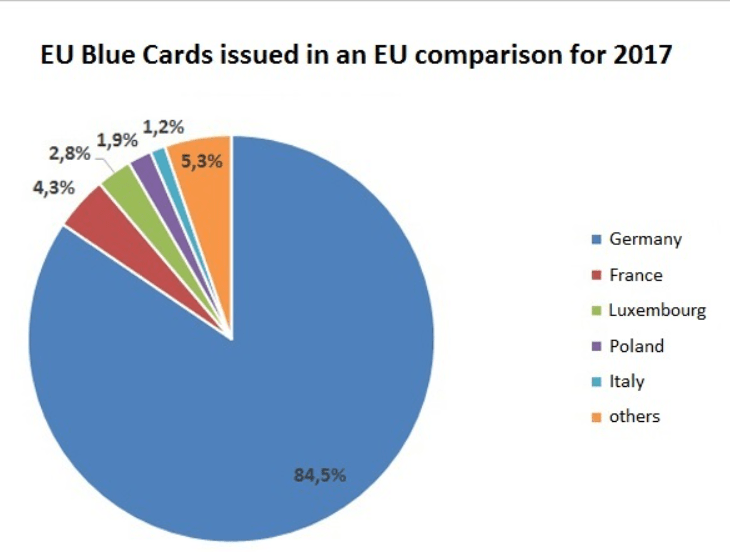
The Blue Card is an agreement involving all European Union countries except two (Denmark and Ireland). But beyond the basic conditions, each country has also set its own criteria and acceptance requirements. Looking at the statistics below from 2017 (unfortunately, I couldn’t find the most recent figures), we can see that Germany was far ahead of the other countries.
The second important issue, of course, was financial. When talking about financial opportunities, I think the best comparison is the relationship between salary and the cost of living. In our research, we learned that Switzerland paid software engineers the highest salaries after the United States. But Switzerland was also one of the most expensive countries in Europe in terms of the cost of living and expenses. In other words, the difference between the salaries paid in Germany and Switzerland would be offset by the cost of living and expenses. Put another way, although Germany didn’t offer the highest salaries, it was among the countries where salaries allowed you to live comfortably while also saving money.
Being able to buy things with that salary is just as important as how much you earn. Rather than relying on posts that have long been popular in Turkey, like “a grocery receipt from Germany,” we had actually had a chance to observe this through people close to us. Our relatives living in Germany could comfortably afford assets like a house or a car (usually very good models)—things that are now almost out of reach in Turkey even on two engineers’ salaries.
Even without direct savings, low-interest bank loans, such as mortgages, helped a lot. When we researched all these things ourselves, approached the information with skepticism, and took advantage of the digital age—checking prices for new and used cars in Germany and for electronics online , we came to this conclusion: although it wouldn’t be right to call Germany a very cheap country, salaries in Germany definitely have significant purchasing power compared with other European countries.
In addition to financial opportunities, since we wanted this move to be a lasting change for us, the country’s attitude toward immigrants was also very important. Germany has an undeniable connection with Turkey through a labor agreement signed a long time ago. It also has a sizable Turkish immigrant population. Although a recent decision had abolished dual citizenship, permanent residency was still an achievable option, and there were many people around us who had obtained it.
In addition, the fact that Germany planned to attract skilled immigrants to make up for its aging population, needed thousands of specialists in their fields every year, and planned to introduce new laws to attract skilled workers was often mentioned in the press .
I’d even like to share an update about this to show how Europe is competing to attract skilled workers. In the first days after we moved to Germany, there was a lot of excitement in the country. Angela Merkel, who had led Germany for years, was reaching the end of her term, and Germany was preparing to elect its new leader and government.
The election resulted in a three-party coalition, and the parties agreed to form a government. One of the first things announced in the government program was “making immigration easier.” In this context, dual citizenship was brought back, and it was also made possible to become a dual citizen after five years. Both preventing irregular migration and attracting skilled workers to close the labor shortage had become top priorities for the new government. In the European competition, Germany had once again shown me just how eager it was.
Our research into job opportunities, especially in software engineering, showed that there were clearly many possibilities. In addition to global companies and companies with a strong reputation in the software industry, listings also included promising start-ups with high growth potential. It was also a positive sign that German was rarely required and English was enough. In fact, from what we’d read on blogs, it seemed that our dream of starting our own business one day might also be possible through Germany’s start-up support programs.
Of course, not everything was rosy. There was a language barrier waiting for us in Germany. Even though workplaces consisted of international teams and we hardly ever spoke with German interviewers during job interviews, it was clear that the language would be a problem in social life and government bureaucracy in the long run.
Another important problem was that, although Germany’s climate was not as harsh as that of the Nordic countries, it was still harsher than Turkey’s. The temperatures we considered very cold—minus 15 to 20 degrees—were almost normal for January and February.
When we finished our research and weighed the opportunities on one side of the scale against the difficulties on the other, the scale tipped in favor of the opportunities for us, and we began taking concrete steps toward our plan to move to Germany.
We’d like to end this post by wishing you, too, the chance to settle in the country your heart desires after this difficult process.
Goodbye


Hocam merhabalar. Uber in Danimarka teklifini niye reddettiniz?
LikeLike
Selamlar Tayfun,
Öncelikle sorun için teşekkürler. Uber Danimarka’daki pozisyon için görüşmek istediğinde yurtdışı arayışımızın daha ilk zamanlarıydı ve Amerika ilk seçeneğimizdi. Fakat görüşmeden Amerika için vize sponsoru olmadıklarını anlayınca, hemen Danimarka seçeneğini değerlendirmek yerine Amerika’dan vazgeçip Avrupa’daki ülkeleri tekrardan araştırmaya karar verdim. Bu sebeple bir adım geri atarak Uber ile olan süreci orda sonlandırdım.
LikeLike
Cevabınız için teşekkürler hocam, sağolun.
LikeLiked by 1 person