Hello everyone! 👋
After deciding to move abroad, the most concrete next step is probably applying for jobs and going through the interviews that follow. Having been on both sides of job interviews—as someone who has conducted technical interviews and someone who has personally interviewed for a new job many times—I can say that every stage is exciting.
Whether you make a positive or negative impression can come down to a single sentence for either side. Sometimes it’s a rejection email, sometimes a call with good news—the whole thing is more action-packed than even the most action-filled movies.
Without further ado, let’s get started and share our experiences. As I mentioned at the beginning, I’ll talk about my own experiences as an interviewee while also sharing what I learned from interviews I conducted as a technical recruiter. We’ll generally use software engineering as our example, but I believe this post also contains useful details about the overall process and private-sector hiring for people in other professions. So, let’s begin.
The First Step: Getting Noticed
First of all, the first step is to prepare an impressive CV. Since this is a very detailed topic and also our first step, I wanted to cover it in a separate post. You can find my tips for preparing an effective CV in this post .
If our CV is ready, we can start applying. There are many different platforms for applying abroad, of course. I’ll briefly talk about them, but I think one important thing is to set aside time for this. In other words, the more high-quality applications we make, the more we improve our chances. Of course, there are also a few things to pay attention to when applying. Let’s get into the details.
Where and how should we apply?
The first platform for job applications abroad is LinkedIn. It’s the most popular professional networking platform in recent years. If you don’t already have a profile on it, you should definitely create one. The platform has a profile section where you can enter your experience and personal information. It’s very important to provide the most accurate information in this section, in English and in detail. There are two reasons for this. First, when you apply, your LinkedIn profile is often shared with the company that posted the job, and they may visit it to review it again. Second, a well-filled-out profile can catch the attention of “talent hunters,” and you may find yourself in the interview process without even applying.
If our profile is ready, the next step is to start applying for jobs. After filtering job searches by your chosen country and job title, there are two types of application: Easy Apply and Apply. Before explaining the difference, let’s start by sharing an idea I saw on a blog and largely agree with: “Easy Apply, Easy Rejection”.
When LinkedIn’s Easy Apply feature first came out, it became very popular. It was widely used by both candidates and companies. The main reason was that it took candidates almost only ten seconds to apply for a job. Of course, it was useful for companies too: the easy application process encouraged candidates to apply more, and their candidate pools filled up.
For those who haven’t tried it, here’s a summary: you answer any questions the company has, such as how many years of experience you have with a certain technology. Then you enter your personal information, upload your CV, and congratulations—you’ve applied! After that, your CV arrives by email to the person designated by the company, and HR or a technical interviewer reviews the applications one by one.
Although it makes the application process more convenient, afterwards both the technical interviewer and HR have to examine the emails at length and still manage the whole process manually. Imagine receiving hundreds of applications. Even if it’s convenient at the beginning, it soon becomes chaotic and difficult to manage. That’s why it’s no longer a very popular feature. For example, if we filter the 5,600-something Software Engineer openings in Berlin for Easy Apply, the number drops to around 500.
The trend at most companies now is to use an ATS (Applicant Tracking System) integration. LinkedIn’s “Apply” feature directs you to the company’s own careers page. You’re asked to enter your information and upload your CV. Your application then goes into the ATS. These systems make end-to-end candidate tracking possible. Companies can filter applications, start the process with those candidates, and manage the entire process online on a platform accessible to all recruiters. Because of the convenience this offers employers, most companies now expect candidates to take the time to enter their information in detail on their careers sites.
So how does this affect us as candidates? The first problem that comes to mind is the time and effort involved. In the time it takes to submit ten or fifteen Easy Apply applications, we can probably complete one application on a careers site, because we have to enter detailed information.
Speaking from my own experience, I also started my first job search abroad by filtering for Easy Apply jobs on LinkedIn. The reason was simply that I could apply to dozens of companies quickly. But unfortunately, I didn’t get the responses I wanted. After that, I decided to spend more time on applications and submit them one by one with care. I saw a considerable increase in responses as a result of this strategic move. So my first recommendation is to apply through Easy Apply too, but be sure to set aside time to enter accurate, detailed information and apply to other openings as well. This will multiply your chances of getting a response.
One thing is clear: after a while, applying to jobs one after another really becomes difficult. At that point, my advice is to stop applying for the day and start again after some time, feeling more motivated. Applying without enthusiasm actually means very low odds.
Even though Easy Apply and Apply are different, I’d say LinkedIn is always my first choice. Many companies actively use LinkedIn to post job openings, and hundreds of talent hunters across many parts of Europe are trying to find developers for their clients by reaching out to talented people, even if they haven’t applied. LinkedIn may be the most popular platform, but it’s not the only option, so let’s look at some others.
Although there are many different options, including Stack Overflow, during our job search, apart from LinkedIn, we only tried our luck on Glassdoor and Indeed . Since we didn’t apply to many jobs on these platforms, I can’t give detailed information, but I’ll mention their names as a reference.
I’d also like to offer another perspective beyond the various job-search sites. Some companies in Europe in particular manage the entire hiring process through their own careers sites. As I mentioned earlier, even companies that post openings on LinkedIn collect applications through their own careers systems. But, unlike that, there are also many companies in Europe that don’t post openings on LinkedIn at all. The company I currently work for does this too. In short, instead of posting job openings on a site such as LinkedIn or Glassdoor, they post them only on the careers page of their company website and manage the entire process there. So the only way to apply to these companies is to go to their careers pages and check their open positions. How can we find these companies?
If you’ve decided on the country or city you want to move to, I recommend including the country in your search first. You can find great blog posts on Google using just a few simple “keywords.” I definitely recommend looking through the careers pages of the companies listed there. For example, we searched for:
- Top Software Companies in Germany
- Best-funded Software Startups in Germany
- Best place to work in Germany
The First Interview, The First Impression
After completing the applications, we start waiting, like a fisherman who has cast a line into the sea. Waiting for responses is a really exciting process. Another exciting moment is having the first interview.
In our experience, the first interview was always with Human Resources (HR). HR interviews are a chance to make a first impression and also for you to understand what the position expects and offers.
HR generally tries to pick out “keywords” from your experience. That’s why I recommend mentioning the technologies you’ve worked with during your first interview. For example, instead of saying, “I worked on project X,” it will make a much better impression to say, “I developed project X using Microservice Architecture and Spring Cloud.” It’s very important to talk about your technologies and experience without going into too much detail, but also without being vague.
They’ll often ask for your salary expectations too. This is an important factor in deciding whether to continue with the process. If they don’t ask, you can also ask what range the company has in mind for the position. After all, you can decide not to continue with the process too.
I don’t think this stage is more than an interview where both sides get to know each other and form first impressions. As long as the conversation isn’t very unenthusiastic or extremely hesitant, you can get through this stage comfortably. If you think you’ll get nervous speaking English, be sure to practice several times before the interview, in English, giving a fluent account of your background from graduating university to the present. This practice will let you describe your past experience smoothly without getting nervous or stumbling. The process generally continues with a technical interview after this stage.
Assignments Before the Technical Interview
Since the position we’re interviewing for is in software engineering, employers naturally expect to see some “hands-on practice.” No matter how exciting our past experience is, at the end of the day we’re expected to prove it to the other side by “getting our hands dirty.” This process varies from company to company. The most common approaches are to send an assignment project or algorithm test before the interview, or to do the coding entirely during the interview.
The “hands-on practice” I mentioned in the introduction has always been debated. Many candidates find it off-putting when, despite having years of experience and having written thousands of lines of code for products used by millions, they are still expected to answer an algorithm question. Although this is open to debate, many companies now expect candidates to answer an algorithm question, write code to solve it, and even test it against edge cases.
Before the pandemic, my former company’s preference was to invite candidates to the office in person and have them answer questions on a whiteboard. Thinking about it now, that seems quite unreasonable, but until four or five years ago, many companies managed their interview processes this way. Although it was almost outdated, it was still a preferred way to measure problem-solving skills.
With the pandemic, demand for “online coding platforms” exploded. Software companies completely changed their technical interview strategies by partnering with sites that lead the field in this area, such as HackerRank or Codility , and took the technical interviewer out of the first stage. In other words, candidates could answer an algorithm question at home at a time of their choosing. Although it seemed like a very good method, it brought along an important problem: “cheating.”
Because of concerns such as questions appearing online very quickly or candidates having someone else take the test for them, confidence in these platforms declined. In addition, these systems often work in a binary way: 1 or 0. In other words, even if you’re on the right track, if you don’t reach the solution, you won’t get the expected threshold score and you’ll be eliminated. In my own process, my first observation was that factors like this pushed recruiters to look for alternatives. After I applied, I received only a few tests from platforms like HackerRank or Codility.
So, what’s the trend now? Although the method is still debated, based on my observations I can say that the old interview method has made a comeback in digital form and is back in first place. The technical interviewer has returned to the process. When the interview starts, they share a code editor link where you can make changes. The interviewer writes a question, then the candidate starts writing code in the editor. The technical interviewer can intervene at any point. In fact, interviews that used to take place in person have moved from the whiteboard and meeting room to an online interview and editor. I’d say 80% of the interviews I took went this way.
Regardless of the method used, an “Algorithmic Challenge” is always a very important part of a Software Engineer job interview, regardless of experience. If anyone is nervous about or intimidated by algorithm questions at this stage, don’t panic just yet. Let me share an example from my own experience here.
This was the part I was most anxious about and perhaps a little afraid of before I started applying for jobs. I had barely written code in the last two or three years of my career, so I had almost no confidence that I could pass this stage. For that reason, before applying, I took a step back and gave myself about a month to prepare. During that time, in the hours left after my regular work—and often after work hours—I followed a plan to brush up on my knowledge before starting all my applications. So, how did I spend this preparation boot camp?
First, my advice is to solve one or two algorithm problems every day—or as often as you can. You can do this by creating an account on sites like HackerRank, LeetCode . Since these sites turn solving algorithms into a game, you can make it fun by starting at the easy level, moving to medium, and then to hard, while also seeing your progress. In addition, these sites test not only whether your answer is correct but also its performance, encouraging you to find a solution with the best “Time Complexity.”
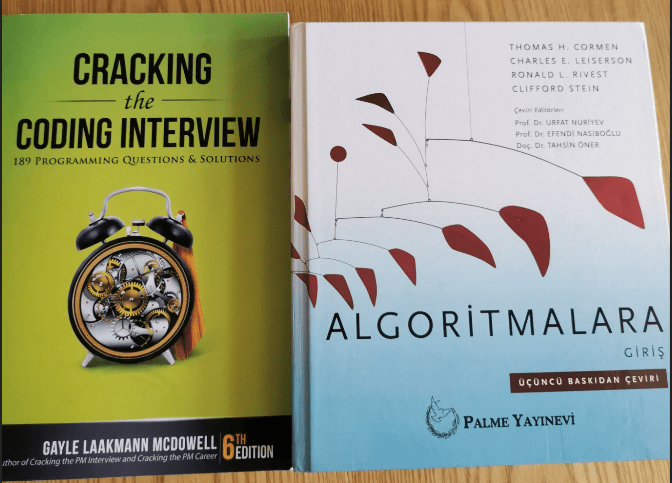
As important as solving algorithm problems is understanding the logic behind them and finding the best-performing solution among the possible options. Two books that really helped me examine algorithm problems by starting with the math and considering different approaches were especially useful. I recommend reading them too. You probably won’t finish these books in a month, but you’ll still benefit a lot from getting as far as you can.
- Cracking the Coding Interview, Gayle Laakmann McDowell
- Introduction to Algorithms (I used the Turkish translation), Thomas H. Cormen
After sharing my experience with algorithm questions, let me now talk about tasks given as requirements, which work like a small demo project.
You’re generally expected to complete the requirements within about a week, and sometimes even deploy them to the provided servers in a working state. Since these tasks are like a small-scale project done in addition to your current job, candidates understandably criticize this method. But in my experience, there are still a small number of companies that send tasks this way.
So, how does the process work? First, they send you the requirements. They also tell you how to submit the code—sometimes through a GitHub account, sometimes by emailing a zip file to the company—and if deployment is required, they provide the server information too. Then during the technical interview, you review the code together. Although the tasks are based on the technical topics the position requires, for the positions I applied to they were generally different versions of “CRUD applications” came in different versions.
For this stage, my advice is to carefully “review” your code before submitting it. Working code alone doesn’t unfortunately mean that you’ll pass the interview. Code standards and the design patterns you follow are generally points technical interviewers focus on.
Another important point is to write unit tests and even integration tests. This will definitely be a plus. In particular, if you’re asked to build a RESTful web service, the standards you need to follow when designing the API can cause problems, as happened to me in one of my tasks. For RESTful API standards, I recommend this resource .
Is It Only About Algorithms and Coding?
First, perhaps the right question is, “Is there only one technical interview?” Based on my own experience, I can say that sometimes they split the technical interviews and hold two or three separate ones instead of one long technical interview. We started the post with algorithms because they’re the most important topic, but of course technical interviews also begin with the candidate being expected to describe their past experience. Unlike in the HR interview, it’s very useful at this stage to talk about technical details, architecture, and technologies used in the projects you’ve worked on.
Besides that, technical interviewers also want to hear about how the project is used from the “user” perspective—in other words, the “Use Cases.” Rather than going into these details for every project, I recommend choosing one project and steering the conversation in the direction you want by discussing these aspects. You can choose a project you know much better and focus on that one during the interview.
In today’s software world, many companies are looking for T Shaped Software Engineers . In short, rather than Java Specialists or Frontend Specialists, they’re looking for people who can do full-stack software development, write automated unit or integration tests when needed, and even help set up and maintain infrastructure. For this reason, especially if you have cloud experience, I recommend researching how these products are deployed and how feasibility or load balancing is handled. These questions came up very often in my interviews. In fact, after I stumbled on Docker and Kubernetes questions in my first two technical interviews, I took a course on Udemy and prepared that way for the third one.
Asking Questions
If everything goes well and you pass the technical stage—which, as I said above, may include more than one technical interview—the next interview is usually with a manager two or three levels above. This might be the Head of Engineering, Director of Engineering, Product Owner, or Project Manager.
In interviews with managers at this stage, rather than technical details, the conversation is more likely to cover the product’s features—or, in other words, its “Use Cases”—the product’s future, or potential features that could be added. Most of the time, the manager wants to see your curiosity and vision. The more interested you are in the product or project and the more ideas you share about it, the better your chances. Let me continue by sharing an unfortunate experience of mine.
I had started a process with a company in Germany. After getting through two technical stages that were entirely about solving algorithms, discussing design, and answering architecture and infrastructure questions, I moved on to an interview with a “Senior Product Owner.”
The interview had really started well for me. I thought I was expressing myself very well and was moving forward with confidence. When it was the other person’s turn to speak, the Product Owner described the project in detail. I listened eagerly and took notes. Then they said, “Now we can move on to your questions.” I responded very positively, wanting to show that I understood everything: “Thank you very much for the detailed explanation. I understood everything very clearly.” We ended the interview there.
Since I found the project and technologies exciting and thought the interview had gone well, I was relaxing happily afterwards. Just then, a call from Germany got me excited. My first thought was that they were calling about the next stage or an offer. But I was wrong.
The caller was the HR representative with whom we had started the process. In a somewhat disappointed voice, they told me they had received negative feedback from the interview. I was very surprised. If it had been a Q&A session on technical topics and I hadn’t been able to answer the questions, I could understand. But why had an interview that was entirely a conversation gone badly? I couldn’t make sense of it and asked for the reason. I was even more surprised by the answer.
I had received negative feedback because I hadn’t asked any questions. Even though I usually make sure the other person can feel my enthusiasm and interest in the position, it turned out that asking questions and trying to learn about the project details were also important qualities that affect interviews. I was a little disappointed, but glad to have gained a new experience, and we had to end the process.
Staying in the Process
Although the adventure of moving abroad begins with a long and tiring process, staying motivated and believing in yourself throughout is the most important thing. Experiencing failures along the way, and sometimes being disappointed just when you think it’s finally going to work out, are difficult challenges to overcome. My own story began where hope had run out.
I started the process focused on Germany, and after many attempts, I got quite far with one company. After passing five stages, I had a pleasant interview with a recruiter with the title Director of Engineer, and then I started waiting. Five or ten minutes after the interview, HR called and said they wanted to arrange one more interview that same day—and it would be the final one. They were even in a hurry, saying, “If you’re available in half an hour, we can arrange it right away.” Naturally, I accepted with great excitement.
By the time the interview invitation email arrived, my spouse and I had already started dreaming. There was only one interview left between us and a ticket to Germany. Since this was the final interview, I assumed they wanted a senior manager to meet the candidate and give final approval. That was the routine process at my current company too.
When the invitation arrived, it didn’t say who I’d be meeting with; it only said “Bar Raiser Interview.” At first I didn’t understand what it meant at all. After doing some research, I realized it was actually a type of interview introduced by Amazon . Think of the weight bar at a gym: if a person on either side can’t lift a similar amount of weight, the bar will tilt to one side. To prevent this, someone from outside the department you’re interviewing with also interviews you. Of course, this includes both technical and behavioral questions. This news really disappointed me. It felt as though we had suddenly gone back to the technical interviews I’d completed and passed weeks earlier.
In this low mood, I started the technical interview. The interviewer turned out to be a manager on a team that worked with databases. He had never used Java or Spring in his life and had a role more like a Database Administrator. In other words, none of our past experience overlapped. On top of that, databases were a weak point for me. I didn’t have much experience with them.
As the interviewer asked questions about the areas he knew well, my hopes for how the interview was going faded. Another important factor was that I felt an immense unwillingness to do this technical interview, which had appeared so unexpectedly. I had already mentally checked out of the process. I received the rejection email shortly after the interview ended.
Meanwhile, thinking that my process in Germany was almost certain to succeed, my spouse had accelerated their applications in Germany and had nearly reached the offer stage with a company. Of course, this sudden bad news dampened our spirits.
After a brief period of sadness, I pulled myself together and started applying in Germany again without slowing down. One of the responses I received was very interesting. The email was entirely in German. I translated it into English, then replied and added that I didn’t know German, and we arranged an interview. After that, luck finally smiled on me and I received an offer from that company. I still work there. Life had closed one door and opened another.
After sharing all these experiences at length, my biggest advice is to “want it” and “believe in it.” If you can picture yourself in the job you’re about to start, that energy will carry over into your interviews too.
Wishing everyone success in finding the job they dream of;
Goodbye

